How to Tie a Scarf Around a Low Ponytail
A scarf ponytail is easiest to manage when the scarf does not have to do the work of a hair elastic. Build a comfortable ponytail first, then add the fabric around its base. That separates support from decoration and makes it easier to correct the scarf without rebuilding the hairstyle. This guide uses a small, lightweight scarf folded into a band and tied in a simple double overhand knot. You can leave the tails hanging or make a small bow, but avoid oversized fabric that keeps sliding or dragging the ponytail down.
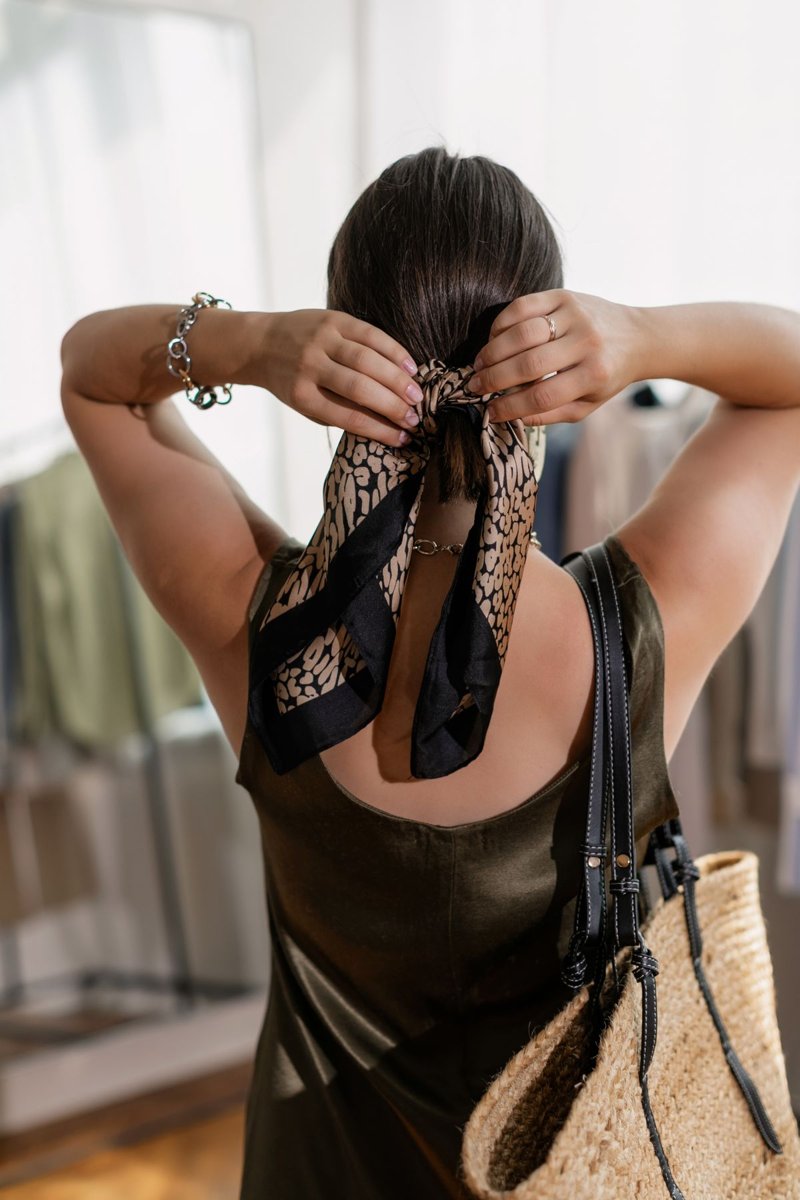
Photo: Alena Darmel · Photo license. Hairstyle reference photograph; follow the written steps and adapt to your length and texture. The pictured person is not an author or endorser.
Best suited to: Best starting point: a comfortable low ponytail. The elastic supports the hair; the scarf is a decorative finishing layer.
What you need
- A covered elastic
- A small lightweight scarf with finished edges
- A mirror and a clear surface for folding the scarf
Step by step
- Make a low ponytail and check that the elastic is secure without pulling. Move your head normally before adding fabric. If the base already slips or feels tight, fix it now; the scarf should not conceal a fastening problem.
- Spread the scarf on a clean surface and fold it into a band. For a square scarf, fold opposite corners together into a triangle, then fold the long edge toward the point in manageable strips. Keep the finished band flat rather than rolling it into a hard cord.
- Hold the band at its midpoint and place that midpoint beneath the ponytail base. Bring both ends upward around the outside of the elastic. Keep fingers between the fabric and hair so loose strands are not wrapped into the knot.
- Cross one scarf end over the other, pass it underneath and bring it through to make the first overhand knot. Position it above or beside the elastic. Tighten only enough to settle the fabric around the elastic, not to compress the hair against the head.
- Make a second overhand knot by crossing the opposite end over the other and bringing it through. Alternating the crossing direction helps the two knots lie more neatly. Keep both tail ends in sight so they are easy to untie later.
- Arrange the tails to a length that stays clear of your face and the task you are doing. If they are too long, use a smaller scarf rather than tucking bulky loops around the base. Check how the knot sits from the side and back.
- Test a few gentle head movements. If the scarf slides, untie it and refold into a flatter band or choose a less slippery, lighter scarf. At removal, untie the scarf first, set it aside and then release the elastic separately.
Choose scale before pattern
A scarf that looks attractive on a table may be too large for a small ponytail. Compare its folded width with the ponytail base and check the finished tail length while standing, not just while leaning toward a mirror. Fine hair often suits a narrower band and a small knot. A fuller ponytail can visually balance more fabric, but the scarf still should not feel heavy. Smooth fabric can be more prone to slipping around an elastic; try another scarf before deciding the solution is a tighter knot.
Try a bow without a bulky center
If you prefer a bow, begin after the first overhand knot. Make a small loop with one end, bring the other end around that loop and pull a second loop through the opening. Adjust the loops while holding the center rather than tugging hard on the ponytail. This is the familiar shoelace-style bow, but scarf fabric can be much thicker than a lace. If the center becomes large and hard, return to two simple knots or choose a thinner scarf. Decoration should sit on the base, not create pressure against the nape.
Make the accessory fit the day
Hanging fabric can catch on bags, high collars and moving equipment. Keep scarf tails away from machinery, cooking flames and activities where loose fabric is unsuitable; remove the scarf when needed. A ponytail accessory is not protective equipment. For a desk day, check that the knot is not pushed into the back of your head by the chair. If you wear earrings, turn your head to see whether the fabric catches them. These small checks make an accessory feel intentional instead of something you have to keep adjusting.
Your quick checklist
- The ponytail supports itself before adding the scarf.
- No loose hair is trapped inside the knot.
- The knot can be reached and untied easily.
- Fabric tails are clear of anything that could catch them.
Common questions
Can the scarf hold the ponytail without an elastic?
That is a different construction and can slip easily. In this tutorial, the covered elastic provides support and the scarf supplies the visual detail.
Can I use a long neck scarf?
Only if its weight and tail length suit the hairstyle and activity. A small lightweight scarf is the simpler starting point; do not compensate for excess fabric by tying it harder.
Why are the two knots twisting?
You may have crossed the same end over both times. Undo the knots, flatten the band and alternate which end crosses over for the second knot.