A Loose Fishtail Braid: Alternate Small Outer Sections Between Two Halves
A fishtail braid begins with two main halves and transfers small sections from one outside edge to the other. Practice where you can see your hands, using hair that reaches comfortably. Keep the base loose and undo the style if it pulls or hurts.
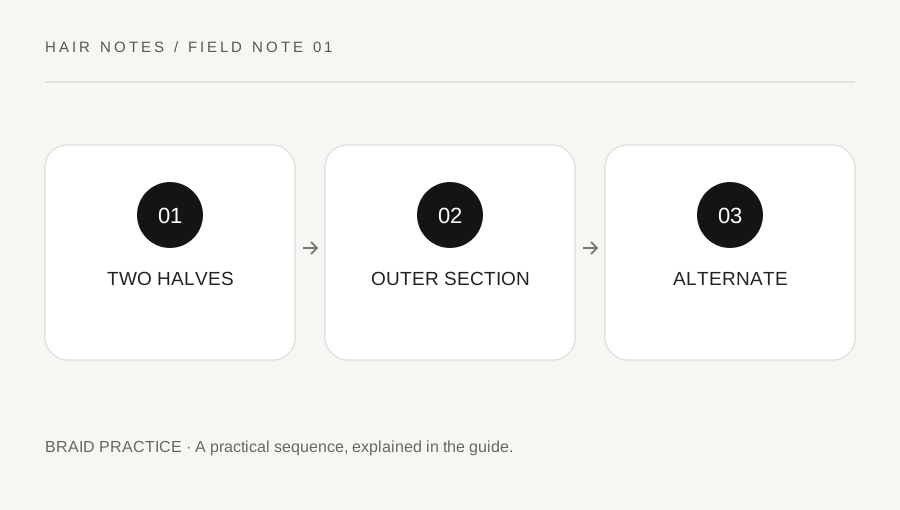
Original explanatory diagram. Examples illustrate a method or decision; they are not claims of personal testing.
Prepare a visible practice position
Use a comfortable position with a mirror and a suitable gentle detangling method for your hair. Do not brush through resistance forcefully. Bring the length to one side if that lets you see the process without twisting your neck. Keep an appropriate hair tie within reach.
This is a loose free-hanging braid, not a tight scalp-braiding method. If hair is too short to hold the sections comfortably, practice on a suitable model or choose another style. Do not pull the roots tighter to create extra working length.
Divide into two main halves
Separate the gathered length into left and right halves. Hold them so the outer edges remain distinguishable. Take a small section from the outside of the left half and cross it over the top to join the inside of the right half.
The transferred section now belongs to the right half. You still have two main halves rather than three independent working strands. Keep your hands at a comfortable level and avoid pulling the transfer tightly against the scalp. Stop and reset if the sections become tangled or difficult to distinguish.
Repeat from the other side
Take a similarly sized small section from the outside of the right half and cross it over to join the inside of the left half. Continue alternating left and right transfers. The repeated outside-to-opposite-half action creates the pattern.
Choose manageable sections rather than trying to make them extremely fine on a first attempt. A larger practice section makes the sequence easier to see. The two main halves change size as sections transfer, so keep observing the outside edges instead of holding a rigid original division.
Secure without chasing perfect symmetry
Stop before the ends become too short to handle comfortably and secure with a suitable tie. Check the braid and root area for pulling. A slightly uneven first pattern is a practice result, not a reason to tighten every crossing aggressively.
If you want a softer outline, adjust only gently where the hair moves freely. Do not tug on resistant sections or use force to enlarge the braid. The style does not need to look identical on every hair texture or length.
Review one transfer pair
For a worked practice, perform only one left transfer and one right transfer, then pause. Name where each section started and which main half it joined. If you can explain that pair, repeat the same sequence farther down the length.
When taking the braid down, remove the tie gently and reverse the crossings without dragging through a knot. Persistent scalp discomfort, breakage or hair-loss concerns need appropriate professional advice. This original styling guide does not claim to diagnose hair conditions or guarantee a particular finish.
Keep a short two-transfer practice note: left outer section joins right half, then right outer section joins left half. Mark each step only after it is completed, so a pause does not leave you guessing which side comes next. If the main halves become uneven, observe the available outside sections and reset gently rather than adding a third permanent strand. Larger sections can make the pattern easier to see during practice, while finer sections create more transfers. Choose manageability over speed. A clear short sequence is a useful result even when you do not continue to a full finished braid.
A practical checklist
Choices are saved in this browser. Reset them here or clear this site’s browser storage.
Questions that come up
Does a fishtail use three main strands?
This method uses two main halves, with small sections transferred from each outside edge to the opposite half. That differs from a basic three-strand sequence.
Why does the pattern look uneven?
Section size and hand control can vary. Practice a short pair of transfers before trying the full length, keeping comfort ahead of symmetry.
Should I pull tighter if short pieces escape?
No. Use a style suited to the available length or allow loose pieces. Do not create root tension to force the shape.
References & scope
Background references checked on 18 October 2026. Worked examples and diagrams are original teaching material.