Use a Flat Barrette on a Small Section Without Forcing the Clasp
A flat barrette closes around a limited section of hair. Choose a section the clasp can hold normally and check for trapped strands before fastening. A clip that will not close comfortably needs a different section or accessory, not more pressure.
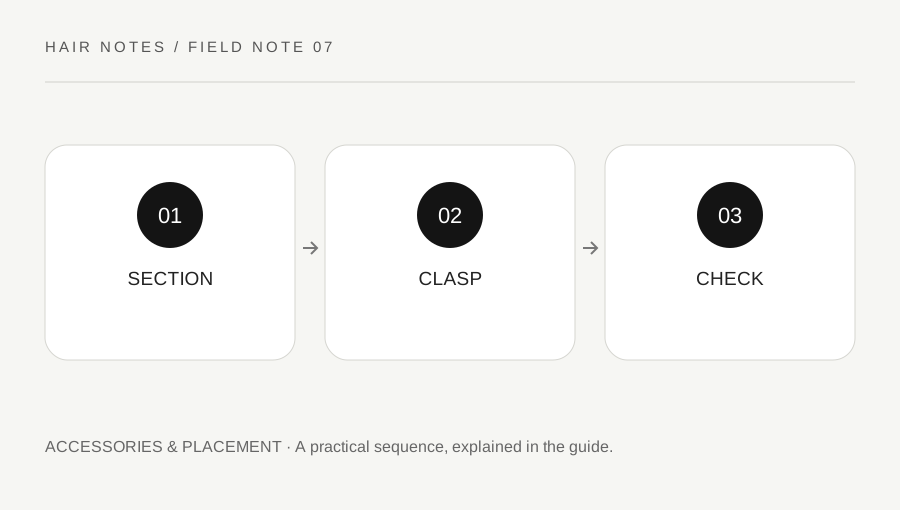
Original explanatory diagram. Examples illustrate a method or decision; they are not claims of personal testing.
Inspect the barrette first
Open and close the empty accessory gently according to its design. Check for bent parts, rough edges or a damaged clasp. Do not use a broken clip near the scalp or attempt to force it back into shape while it is in the hair.
Notice its actual usable space, which may be smaller than the decorative top suggests. A long ornament can still have a small fastening underneath. Use the accessory's instructions where available and choose a manageable amount of hair rather than judging capacity from appearance alone.
Select a modest section
Choose the side or upper section you want to hold and gather it where it reaches comfortably. Keep the rest of the hair separate so loose strands do not become caught in the clasp. A small section can be enough to create the intended visible detail.
Do not pull the hairline tight to feed more hair into the barrette. If short layers escape, allow them to remain loose where appropriate or choose another style. The accessory should support a comfortable arrangement rather than create traction to preserve a smooth outline.
Close the intended mechanism
Place the section within the supported fastening area and close the clasp gently using its normal action. Check that fingers, nearby hair and the scalp are clear. Stop if the clasp resists or the section feels compressed uncomfortably.
Reopen and reduce the section if needed. Do not repeatedly squeeze harder or add an improvised tie inside the mechanism. A barrette's normal closure should remain understandable, and a damaged or unsuitable accessory should be replaced rather than made to hold by force.
Check position and activity context
Move your head normally and inspect whether the barrette presses, catches on clothing or slides. Compare a slightly different comfortable position if the first is awkward. Do not use the accessory as a substitute for activity-specific hair securement.
A heavy decorative top can behave differently from a plain clip. Keep its weight and the day's setting in the decision. If the arrangement needs repeated tightening, choose another section or accessory rather than assuming discomfort is necessary for hold.
Remove with the clasp fully open
Support the section, open the mechanism normally and check for caught strands before lifting the accessory away. Do not drag a closed or partly opened clasp through the hair. Release any snag gently and use an appropriate detangling method if needed.
For a worked comparison, try one small section, then a slightly larger one only if closure remains normal and comfortable. Record the useful amount and placement. Persistent scalp irritation or hair-loss concerns require appropriate professional advice; this original guide is a mechanical styling check, not a treatment claim.
Make the section smaller before testing a second closure if the first attempt resists. Do not repeatedly compress the same hair bundle while trying to hear a click. Compare the empty mechanism again if its normal motion is unclear, keeping it away from the head. After fastening a suitable section, look for one or two nearby strands accidentally entering the clasp from outside the intended area. Release the accessory to free them rather than pulling them through. A useful record distinguishes section capacity, placement and removal, so the next attempt does not depend on forcing the decorative top flat.
A practical checklist
Choices are saved in this browser. Reset them here or clear this site’s browser storage.
Questions that come up
Does a large decorative top mean high capacity?
Not necessarily. Look at the actual fastening space and normal mechanism rather than the ornament’s length.
Should I squeeze harder if it will not close?
No. Reopen, reduce the section or choose another suitable accessory. Do not force the clasp against hair or scalp.
Can I pull it out while partly closed?
Open it fully and release caught strands gently before lifting it away.
References & scope
Background references checked on 18 October 2026. Worked examples and diagrams are original teaching material.